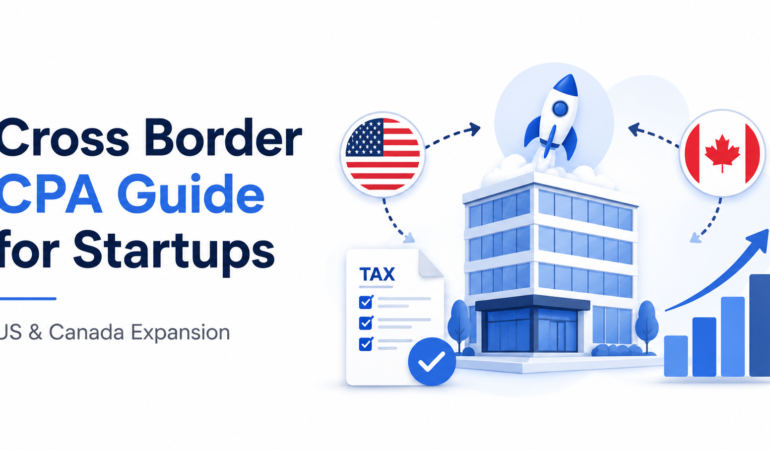
Expanding a startup across the U.S. and Canada opens the door to new customers, funding opportunities, and strategic partnerships. However, it also introduces complex tax obligations that many founders underestimate.
From permanent establishment (PE) risks to transfer pricing rules and cross-border reporting requirements, overlooking a single compliance issue can lead to unexpected tax liabilities and significant penalties.
This is where Kapil Mahajan CPA Professional Corporation provides value. With expertise in U.S.–Canada taxation, the firm helps startups and growing businesses navigate complex regulations while building tax-efficient structures for sustainable growth.
Working with a Cross Border CPA early in your expansion can help reduce compliance risks, optimize tax planning, and support long-term business success.
Why Every Startup Needs a Cross Border CPA
As businesses expand internationally, tax compliance becomes more than simply filing annual returns. Companies operating in both Canada and the United States must comply with two tax systems, reporting obligations, and treaty provisions.
A Cross Border CPA understands how both jurisdictions interact and can help businesses:
Structure cross-border operations efficiently
Reduce the risk of double taxation
Stay compliant with IRS and CRA requirements
Identify tax-saving opportunities
Support business expansion with strategic planning
Instead of addressing tax issues after they arise, proactive planning can save both time and money.
Understanding Permanent Establishment (PE)
One of the biggest tax risks for growing startups is creating a Permanent Establishment (PE) without realizing it.
A PE generally occurs when a business has sufficient business activity in another country, giving that country the right to tax part of the company’s profits.
Examples include:
Executives working regularly in the other country
Employees negotiating or signing contracts
Maintaining offices or business facilities
Sales representatives conducting core business activities
For example, if a Canadian technology startup hires a U.S.-based executive who regularly closes customer contracts, the IRS may determine that the company has established a U.S. Permanent Establishment.
Similarly, Canadian tax authorities may make similar assessments for U.S. companies operating in Canada.
Working with a Cross Border CPA before expanding operations helps identify these risks early and determine whether operational changes can minimize unnecessary tax exposure.
Transfer Pricing: More Than an Accounting Requirement
Many startups establish separate Canadian and U.S. entities for operational reasons.
Whenever these related entities exchange:
Intellectual property
Management services
Software development
Marketing services
Administrative support
Physical products
they must charge each other using fair market value pricing.
This process is known as transfer pricing.
Improper transfer pricing can result in:
Double taxation
Tax audits
Significant penalties
Disallowed deductions
Increased compliance costs
A properly documented transfer pricing agreement helps demonstrate that transactions occur under arm’s-length principles recognized by both the IRS and CRA.
An experienced Cross Border CPA can help develop documentation that supports pricing methodologies while reducing audit risks.
Understanding Form 5471 and T1134 Reporting
Many founders focus primarily on income taxes while overlooking information reporting requirements.
Two of the most important reporting obligations include:
IRS Form 5471
U.S. persons with ownership in certain foreign corporations may need to file Form 5471.
This form reports:
Corporate ownership
Financial statements
Related-party transactions
Corporate activities
Failure to file can result in substantial monetary penalties, even if no tax is owed.
CRA Form T1134
Canadian businesses with foreign affiliates may need to file Form T1134.
The form provides information regarding:
Foreign subsidiaries
Corporate ownership
Financial information
Cross-border transactions
Late or missing filings can trigger penalties and increased scrutiny from tax authorities.
Working with a Cross Border CPA ensures reporting obligations are identified well before filing deadlines.
Taking Advantage of Cross-Border Funding Opportunities
One advantage of operating in both countries is access to multiple innovation funding programs.
Depending on business activities, startups may qualify for programs such as:
U.S. Funding
SBIR (Small Business Innovation Research)
STTR funding
State innovation grants
Canadian Funding
NRC IRAP
SR&ED tax incentives
Provincial innovation programs
Many startups assume they can freely combine funding from both countries.
However, rules surrounding “double dipping” require careful planning.
Businesses generally cannot claim identical research expenses under both U.S. and Canadian funding programs.
Instead, qualifying costs must be properly allocated and documented.
A Cross Border CPA can help structure accounting records to maximize available incentives while maintaining compliance.
Common Cross-Border Tax Mistakes Startups Make
Growing businesses often encounter issues such as:
Expanding into another country without tax planning
Ignoring Permanent Establishment risks
Missing foreign reporting forms
Poor transfer pricing documentation
Incorrect payroll setup
Misclassifying employees and contractors
Claiming duplicate R&D incentives
Delaying cross-border tax advice until an audit occurs
These issues become more expensive to resolve after they occur than to prevent during expansion planning.
How Professional Cross-Border Tax Planning Supports Growth
As your company grows, tax planning should evolve alongside business operations.
Rather than focusing solely on compliance, proactive planning can help:
Their cross-border expertise helps startups address compliance obligations while supporting strategic growth objectives with practical tax planning.
Choosing the Right Cross Border CPA
Not every accounting professional specializes in cross-border taxation.
When selecting a CPA, businesses should look for experience with:
U.S.–Canada Tax Treaty
CRA and IRS compliance
Transfer pricing
Cross-border business structuring
International reporting requirements
Startup tax planning
Cross-border funding programs
Choosing an advisor with specialized knowledge can help prevent costly mistakes before they affect business operations.
Conclusion
Scaling across the U.S. and Canada creates exciting opportunities, but it also introduces tax complexities that require careful planning.
From Permanent Establishment risks and transfer pricing to foreign reporting forms and funding strategies, each decision can have lasting financial consequences.
Partnering with Kapil Mahajan CPA Professional Corporation gives startups access to experienced guidance designed to simplify cross-border taxation while supporting sustainable growth.
Whether your business is entering a new market, establishing a subsidiary, or planning future expansion, working with a knowledgeable Cross Border CPA can help you stay compliant, reduce tax risks, and focus on building your business with confidence.
A Cross Border CPA helps individuals and businesses manage tax planning, compliance, reporting, and financial strategies when operating between the United States and Canada.
2. Why is Permanent Establishment important for startups?
Permanent Establishment can give another country the right to tax part of your business profits. Proper planning helps businesses understand and manage this risk before expanding.
3. What is transfer pricing?
Transfer pricing refers to the pricing of goods, services, intellectual property, or other transactions between related companies operating in different countries. Proper documentation is essential for tax compliance.
4. Can startups receive funding from both Canada and the United States?
Yes. Many startups can qualify for funding programs in both countries, but eligible expenses must be properly allocated to comply with double-dipping rules.
5. When should a business hire a Cross Border CPA?
Businesses should consult a Cross Border CPA before expanding into another country, opening a subsidiary, hiring cross-border employees, or engaging in international transactions. Early planning can help reduce tax risks and avoid costly compliance issues.
Why Canadian Taxpayers Lose US Income Without Proper Filing
Kapil Mahajan CPA Professional Corporation provides specialized cross-border tax support for individuals and businesses earning income between the United States and Canada.
Many Canadian taxpayers unknowingly lose up to 30% of their US income because the W-8BEN form is missing or incorrectly filed. In most cases, US payers are legally required to apply default withholding when documentation is incomplete or missing treaty claims.
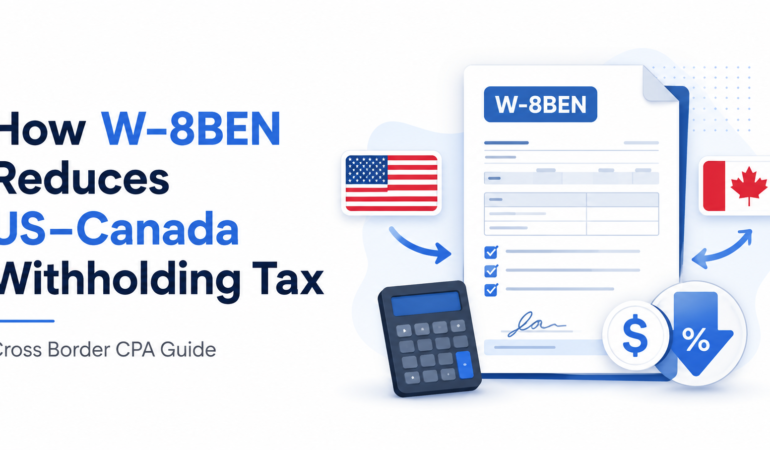
The W-8BEN form certifies non-US tax status and enables Canadian residents to claim benefits under the US–Canada tax treaty, which often reduces withholding significantly depending on income type.
A Cross Border CPA ensures correct filing so taxpayers avoid unnecessary withholding and remain fully compliant with IRS rules.
Disclaimer: Tax treaty regulations, withholding tax rates, and related tax provisions are subject to change. Readers should verify the latest applicable laws and consult a qualified tax advisor before relying on the information provided in this article.
What is the W-8BEN Form and Who Needs It
The W-8BEN form is an IRS compliance document used by non-US individuals to declare foreign tax residency and claim treaty benefits.
It is commonly required for Canadians receiving:
US freelance or consulting income
Dividend or interest income from US investments
Royalty or licensing income
Remote contract or platform-based income
Without proper submission, the IRS applies a default 30% withholding rate regardless of eligibility for treaty relief.
A Canada US Tax Accountant Toronto helps determine correct income classification and ensures treaty claims are applied accurately and legally.
Why the US–Canada Tax Treaty Is Important for Withholding Tax
The US–Canada tax treaty exists to prevent double taxation and ensure income is taxed fairly between both countries.
Once a valid W-8BEN form is submitted, the treaty determines how much tax should actually be withheld based on income classification and residency status.
However, incorrect interpretation of treaty articles is a common issue, leading to over-withholding or compliance errors.
A Cross Border CPA ensures proper treaty application and alignment with Canadian reporting obligations.
Withholding Tax Rates Under the US–Canada Tax Treaty
Income Type
Treaty Article
Withholding Rate
Business income
Article VII
0% if no US permanent establishment
Dividends
Article X
15%
Interest
Article XI
Usually 0%
Royalties
Article XII
0% to 10% depending on structure
Incorrect classification or missing documentation often leads to unnecessary tax leakage and reduced net income.
How W-8BEN Reduces US–Canada Withholding Tax Step by Step
Step 1: US income is earned Canadian individuals or businesses receive payments from US clients or institutions.
Step 2: US payer requests W-8BEN form This form is required before payments can be processed without default withholding.
Step 3: Canadian tax residency is declared The taxpayer confirms non-US residency and selects treaty eligibility.
Step 4: Reduced withholding is applied Instead of 30%, treaty-based reduced or zero withholding is applied.
A Cross Border CPA ensures each step is completed correctly to prevent over-withholding and compliance issues.
W-8BEN Tax Reduction Process
US income earned
W-8BEN form requested
Canadian residency confirmed
Income classified under treaty rules
Cross-border tax review completed
US–Canada tax treaty applied
Reduced withholding implemented
Higher net income received
IRS Compliance Risk: What Happens If W-8BEN Is Incorrect
Incorrect filing can create serious tax issues, including:
Excess 30% withholding on all US income
Rejection of treaty benefits
IRS compliance mismatches for US payers
Delays in receiving payments
Potential audit queries in complex cases
This is why professional review by a Cross Border CPA is critical for anyone earning recurring US income.
How to Complete the W-8BEN Form Correctly
Identify yourself
Full legal name
Canadian residential address
Citizenship details
Provide tax identification
Canadian SIN used as Foreign Tax Identification Number (FTIN)
A Canadian consultant working with multiple US clients was consistently facing 30% withholding due to incorrect W-8BEN form filing.
After professional review by Kapil Mahajan CPA Professional Corporation, the Cross Border CPA corrected treaty classification and updated documentation with US payers. This resulted in reduced withholding on future payments and improved cash flow.
Outcome:
Reduced withholding tax burden
Improved compliance accuracy
Better cash flow consistency
Correct treaty application
Avoid Losing Income Due to Incorrect Filing
Incorrect W-8BEN form filing directly reduces your take-home income.
Kapil Mahajan CPA Professional Corporation provides expert cross-border tax advisory services including W-8BEN form filing, treaty optimization, and compliance planning.
Maximize Your US Income Efficiency
Proper W-8BEN form filing ensures Canadian taxpayers are not over-taxed on US income.
With support from a Cross Border tax advisor, you can:
1. What is Form W-8BEN used for in US–Canada tax rules?
Form W-8BEN is used by non-US individuals, including Canadians, to certify foreign tax residency and claim benefits under the US–Canada tax treaty. It helps reduce or eliminate default US withholding tax on income earned from US sources.
2. How does W-8BEN reduce withholding tax for Canadians?
The W-8BEN form allows Canadian taxpayers to apply treaty rates instead of the standard 30% US withholding tax. Depending on income type such as dividends, interest, or business income, withholding can be reduced significantly or eliminated.
3. Who needs to submit a W-8BEN form?
Canadian individuals earning US-sourced income such as freelance payments, consulting fees, dividends, royalties, or online platform income need to submit the W-8BEN form to avoid automatic US tax withholding.
4. What happens if W-8BEN is not submitted correctly?
If the W-8BEN form is missing or incorrect, US payers must apply a default 30% withholding tax. This often results in overpayment of tax and delayed correction unless treaty benefits are properly claimed. In such cases, a Cross Border CPA can help identify errors and correct treaty application to reduce unnecessary withholding.
5. Is W-8BEN required for all Canadian freelancers working with US clients?
Yes, most Canadian freelancers or independent contractors earning US income are required to submit W-8BEN to ensure correct tax treatment under the US–Canada tax treaty and avoid unnecessary withholding. A Canada US Tax Accountant Toronto can help ensure proper classification and accurate cross-border tax compliance.
Everything you need to know about navigating US–Canada dual tax obligations, finding a qualified specialist, and protecting yourself from costly penalties in today’s shifting trade landscape.
What Is a Cross Border Tax Accountant?
A cross border tax accountant is a certified professional — typically a CPA (Chartered Professional Accountant) in Canada or a CPA/EA (Enrolled Agent) in the United States — who specializes exclusively in tax matters that span two or more countries. In the Canada–US context, this means someone who deeply understands both the Canada Revenue Agency (CRA) rules and the Internal Revenue Service (IRS) requirements, along with the bilateral tax treaty that governs how both tax authorities interact.
Unlike a general accountant who may handle cross-border files occasionally, a specialist cross border tax accountant dedicates their practice entirely to international tax compliance. As one leading firm puts it, they don’t “merely dabble” in cross-border work — it is the only thing they do.
“The right cross-border tax advice doesn’t just ensure compliance — it unlocks treaty benefits, eliminates double taxation, and can save thousands of dollars annually.”
For individuals living, working, or investing across the Canada–US border, and for businesses with operations in both countries, these specialists are not a luxury — they are a necessity.
$2.5BWorth of goods & services crossing the Canada–US border every single day
$205Per-day IRS penalty for missing the April 15 US filing deadline
$500+CRA fine for inaccurate returns, plus increased audit risk
183Days in the US that can trigger US tax residency under the Substantial Presence Test
Why 2026 Is a Critical Year for Cross-Border Taxpayers
The Canada–US tax landscape has never been more turbulent. Several major developments in 2025–2026 have reshaped the risk and compliance environment for both individuals and businesses operating across the border.
1. The US–Canada Trade War & Tariff Shockwaves
The US–Canada tariff dispute that erupted in 2025 has created sweeping tax implications. Broad tariffs were applied to key sectors including lumber, automobiles, steel, and aluminum. On February 20, 2026, the US Supreme Court struck down tariffs imposed under the International Emergency Economic Powers Act (IEEPA) — but just days later, on February 24, 2026, the US imposed new global 10% tariffs under Section 122 of the Trade Act of 1974. CUSMA-compliant Canadian goods remain exempt, but the volatility demands expert cross-border tax structuring.
⚠️ 2026 Alert: CUSMA (Canada–United States–Mexico Agreement) is scheduled for a critical review with a targeted date of July 1, 2026. The outcome could significantly affect cross-border business tax structures.
2. Digital Economy & Remote Work Complexity
The rise of remote work has created a new generation of cross-border taxpayers. A Calgary-based employee working for a US firm, or a Vancouver tech professional contracting for Silicon Valley clients, may unknowingly trigger US tax filing obligations, payroll tax issues, or even permanent establishment risks for their employer.
3. CRA & IRS AI-Driven Audits
Both the CRA and IRS are increasingly deploying AI and data analytics tools to identify discrepancies in cross-border filings. Undisclosed foreign accounts, unreported RRSP/TFSA balances, and mismatched income declarations are now flagged faster than ever — making proactive compliance more important than ever.
4. Capital Gains Tax Changes
Canada’s 2024 federal budget introduced changes to capital gains inclusion rates, which have significant downstream effects on cross-border investors, dual citizens selling property, and those planning to exit Canada. A qualified cross border tax accountant helps model the impact under both tax systems.
Who Needs a Cross Border Tax Accountant?
You likely need a specialist if you fall into any of the following categories:
US citizens or green card holders living in Canada — You must file US returns annually, regardless of where you live or where your income is earned.
Canadians working or earning income in the US — Employment income, consulting fees, rental income, and capital gains may all be taxable in the US.
Dual citizens — Subject to the full tax obligations of both countries.
Canadians moving to the US — Departure tax, RRSP treatment, and exit planning require specialist advice before the move, not after.
Canadian businesses with US operations — Permanent establishment risk, Form 1120-F obligations, and state tax nexus issues.
US businesses with Canadian operations — Corporation tax, GST/HST, payroll, and provincial requirements.
Cross-border investors — RRSPs, TFSAs, 401(k)s, IRAs, and brokerage accounts all have different treatment under each country’s tax system.
Canadians with US real estate — FIRPTA withholding, estate tax exposure, and rental income reporting.
Snowbirds spending extended time in the US — Risk of triggering US tax residency under the Substantial Presence Test.
Core Services Provided by Cross Border Tax Accountants
Dual-Country Tax Return Preparation
The foundation of cross-border tax practice. A specialist prepares both your Canadian T1 (or corporate T2) and your US Form 1040 (or 1120), ensuring income is correctly reported and foreign tax credits are applied so that you don’t pay tax twice on the same dollar.
FBAR & FATCA Compliance
US citizens and green card holders with Canadian financial accounts exceeding US$10,000 in aggregate must file FinCEN Form 114 (FBAR) annually. Separately, FATCA requires disclosure on Form 8938 if specified foreign financial assets exceed certain thresholds. Failures trigger severe penalties — often exceeding the account balance itself.
Canadian Foreign Property Reporting (T1135)
Canadian residents who own foreign property (including US real estate, US brokerage accounts, or shares in US corporations) with a cost exceeding CAD $100,000 must file Form T1135 with the CRA annually.
Retirement Account Planning
RRSPs, TFSAs, 401(k)s, and IRAs all carry complex cross-border implications. RRSPs generally receive tax-deferred treatment under the treaty. TFSAs, however, do not receive treaty protection from a US tax perspective — US tax must be paid on TFSA earnings annually, and reporting obligations are onerous. A cross border tax accountant helps clients structure withdrawals, contributions, and elections optimally.
Business Structuring & Permanent Establishment Analysis
A Canadian company with a US employee who regularly closes deals, or a fixed US office, may have created a taxable “permanent establishment” in the US — triggering IRS filing obligations even without realizing it. Cross border tax accountants assess these risks and help restructure operations to minimize exposure.
Estate & Departure Tax Planning
When a Canadian resident leaves Canada, they face a deemed disposition of assets — a “departure tax” on unrealized capital gains. The US estate tax can also apply to Canadians who hold US situs assets. Early planning with a specialist can significantly reduce these costs.
Service
Who It’s For
Key Forms Involved
Deadline
US Individual Tax Return
US citizens & green card holders in Canada
Form 1040 / 2555 / 1116
April 15 (June 15 extension for expats)
Canadian Individual Tax Return
Canadian residents with US income
T1, Schedule A, T1135
April 30
FBAR Filing
US persons with foreign accounts > US$10,000
FinCEN 114
April 15 (auto-ext to Oct 15)
FATCA Reporting
US persons with foreign assets above thresholds
Form 8938
With tax return
Foreign Property Report
Canadian residents with > CAD $100K foreign assets
T1135
April 30
Corporate US Tax Filing
Canadian corporations with US income
Form 1120-F, Form 8833
15th day of 6th month after year-end
Departure Tax Planning
Canadians emigrating to the US
T1161, T1243, T1244
Year of departure
Cross Border Tax Accountant in Calgary: What You Need to Know
Calgary’s booming energy sector, entrepreneurial landscape, and proximity to the US make it a hub for cross-border economic activity. Alberta has no provincial income tax on capital gains and no provincial sales tax (PST), making it tax-advantaged provincially — but these provincial benefits don’t insulate Albertans from US federal tax obligations.
Calgary-Specific Cross-Border Tax Situations
Oil & gas professionals working on US projects or for US subsidiaries
Tech startup founders incorporating in Delaware while living in Calgary
Real estate investors holding properties in Arizona, Nevada, or Texas
Snowbirds wintering in the US (Arizona is especially popular among Calgarians) — risking Substantial Presence Test violations
US-born professionals working in Calgary’s financial or energy sector
What to Look for in a Calgary Cross Border Tax Accountant
Dual credentials: Canadian CPA and US CPA or IRS Enrolled Agent (EA)
Experience with Alberta-specific business structures (partnerships, trusts)
Familiarity with the energy sector’s unique US tax treaty implications
Proactive communication — especially around volatile tariff and trade policy changes
Transparent fee structures (typical range: CAD $3,000–$8,000 per entity annually)
Cross Border Tax Accountant in Vancouver: Key Considerations
Vancouver’s unique position as a Pacific gateway, combined with its large dual-citizen population, robust tech industry, and significant real estate market, creates a high concentration of cross-border tax complexity. British Columbia also imposes a Foreign Buyers Tax and speculation taxes that interact with US tax reporting in non-obvious ways.
Vancouver-Specific Cross-Border Tax Situations
US citizens who immigrated to Vancouver and still hold US citizenship
Tech workers employed by Seattle-area companies (Amazon, Microsoft, Meta) while living in Vancouver
Real estate investors with both Canadian and US property holdings
Entrepreneurs building companies with investors on both sides of the border
Film & entertainment professionals working cross-border productions
Vancouver-Specific Considerations
BC’s Foreign Buyers Tax does not create a US tax deduction — but the interplay with FIRPTA withholding on US properties needs careful management
The BC speculation and vacancy tax (SVT) is a provincial tax — not creditable against US federal tax
Vancouver’s proximity to Seattle makes “telecommute” employment arrangements common — and frequently mishandled from a tax perspective
Real estate capital gains in BC are subject to both CRA and potentially IRS reporting
Pacific gateway with large dual-citizen and tech-worker population; complex real estate overlay
Focus: tech, real estate, entertainment
Key risk: deemed US residency, PFIC issues
Common forms: 1040, FBAR, Form 8938
Avg. engagement: CAD $3.5–$9K/yr
The US–Canada Tax Treaty: Key Provisions Every Taxpayer Must Know
The Canada–United States Tax Convention (most recently updated by protocol) is the foundational document governing how the two countries allocate taxing rights and prevent double taxation. Understanding its key provisions can mean the difference between a significant tax bill and a manageable one.
Income Type
Standard Treaty Rate
Conditions
Dividends (substantial ownership)
5%
If recipient owns 10%+ of voting shares
Dividends (other)
15%
Standard portfolio dividends
Interest
0%
Generally exempt between unrelated parties
Royalties
0%
Generally exempt under treaty
Pensions / RRSPs
Tax-deferred
Treaty deferral applies to most taxpayers
TFSAs
No treaty benefit
Annual US taxation required; complex reporting
Tiebreaker Rules
If a person qualifies as a tax resident of both Canada and the US, treaty tiebreaker rules apply. These evaluate factors in order: permanent home, centre of vital interests, habitual abode, and citizenship. A cross border tax accountant analyzes these factors carefully to determine treaty residency — which can dramatically affect overall tax liability.
Compliance Checklist: FBAR, FATCA, CRA Reporting & More
For US Citizens & Green Card Holders in Canada
File US Form 1040 annually, reporting worldwide income — even if all income is Canadian-source and Canadian tax has been paid.
File FBAR (FinCEN 114) if aggregate foreign (Canadian) financial account balances exceeded US$10,000 at any point in the year.
File Form 8938 (FATCA) if specified foreign financial assets exceed applicable thresholds (US$50,000 for individuals filing single; higher for married filing jointly and those residing abroad).
Report Canadian RRSPs and pension plans on Form 8938 if thresholds are met — and ensure proper treaty deferral elections are in place.
Do not contribute to TFSAs without understanding the US tax consequences — consider closing existing TFSAs before US tax residency commences.
Claim the Foreign Tax Credit (Form 1116) to offset Canadian taxes paid against US tax liability and eliminate or reduce double taxation.
For Canadian Residents with US Income or Assets
File Canadian T1 reporting worldwide income, including all US-source income.
File T1135 (Foreign Income Verification Statement) if cost of foreign property exceeds CAD $100,000.
Apply for an ITIN or EIN if required for US withholding purposes or US entity ownership.
File US Form 1040-NR if you have US-source income not fully covered by treaty withholding.
Monitor days spent in the US carefully — 183+ days (using the three-year formula) can trigger US tax residency.
Penalties for Non-Compliance: The Cost of Getting It Wrong
⛔ Critical: Non-compliance with cross-border tax filing obligations can result in penalties that far exceed any tax owed. In some cases, FBAR penalties alone can consume the entire account balance.
Violation
Penalty
Notes
Late US tax return (no tax owed)
$205+ per return
Per day in some circumstances
Inaccurate CRA return
$500+ fine
Plus increased audit risk
FBAR non-willful violation
Up to $10,000/violation
Per account, per year
FBAR willful violation
Greater of $100,000 or 50% of account balance
Per account, per year; criminal charges possible
Failure to file Form 8938 (FATCA)
$10,000–$50,000
Plus 40% accuracy penalty on underpayments
Failure to file T1135
$100–$1,000/month
Up to 24 months; increased with gross negligence
Missing April 30 CRA deadline
5% of balance owing + 1%/month
Doubles if repeated in subsequent 3 years
The IRS does offer amnesty programs — including the Streamlined Foreign Offshore Procedures and the IRS Voluntary Disclosure Program — for taxpayers who have fallen behind on US filings. A cross border tax accountant can guide you through these programs to come into compliance while minimizing penalties.
How to Choose the Right Cross Border Tax Accountant
Not all accountants who advertise cross-border services have the depth of expertise required. Here is a framework to evaluate candidates:
Step-by-Step Vetting Process
Verify dual credentials — Look for a Canadian CPA designation and a US CPA license or IRS Enrolled Agent (EA) designation. Both are necessary for full-scope service.
Assess specialization depth — Ask what percentage of their practice is cross-border. A firm where cross-border is the only service is preferable to one where it is a sideline.
Request client references in situations similar to yours (individual expat, business owner, investor, etc.).
Understand the fee structure upfront — Typical engagements range from CAD $1,500 for a straightforward dual return to $5,000–$10,000/month for complex corporate structures.
Evaluate communication responsiveness — Cross-border tax questions often arise with urgency; your accountant must be proactive and accessible.
Ask about technology and AI tools — In 2026, leading firms use AI-assisted compliance monitoring to catch emerging risks before they become problems.
Cross-Border Tax Is Complex — But Manageable With the Right Specialist
Navigating US–Canada cross-border taxation is genuinely one of the most complex areas in North American tax law. The interplay of two separate tax systems, a bilateral treaty with nuanced provisions, stringent foreign reporting requirements, and now a volatile tariff and trade environment create a landscape where even well-intentioned taxpayers can face severe consequences for simple errors or omissions.
Whether you’re a US citizen building a life in Calgary, a Vancouver entrepreneur expanding into the US market, a snowbird enjoying Arizona winters, or a Canadian business with US operations, the stakes of getting it wrong are too high to leave to generalists.
A qualified cross border tax accountant in Calgary or Vancouver — someone who holds dual credentials, practices exclusively in cross-border matters, and stays current on treaty developments, IRS/CRA guidance, and trade policy changes — is an investment that pays for itself many times over through tax savings, penalty avoidance, and peace of mind.
Questions to Ask a Prospective Cross Border Tax Accountant
“What software platforms do you use for cross-border compliance tracking?”
Do I need to file US taxes if I’m a US citizen living in Calgary or Vancouver?
Yes. The United States taxes its citizens on worldwide income regardless of where they live. As a US citizen residing in Canada, you must file a US federal tax return every year. The US–Canada Tax Treaty and the Foreign Tax Credit help reduce or eliminate double taxation, but filing is mandatory.
Can I avoid double taxation as a cross-border taxpayer?
Generally yes, through three mechanisms: (1) the Foreign Tax Credit, which allows you to offset taxes paid in one country against liability in the other; (2) treaty-based exemptions and reduced withholding rates; and (3) proper structuring of income and entities. A qualified cross border tax accountant ensures these mechanisms are optimally applied.
What is the Substantial Presence Test and how does it affect Canadians spending time in the US?
The Substantial Presence Test counts US days across three years using a formula: all days in the current year + 1/3 of days from the prior year + 1/6 of days from two years prior. If this total reaches 183, you may be treated as a US tax resident. Many Calgary and Vancouver snowbirds unknowingly meet this threshold. Treaty tiebreaker provisions may offer relief, but careful day-tracking and planning are essential.
Should I close my TFSA before moving to the US?
Many cross-border tax specialists recommend closing TFSAs before becoming a US tax resident, as TFSAs do not receive treaty protection from a US perspective. US taxes apply to TFSA earnings annually, and the IRS may classify the TFSA as a foreign trust, triggering complex Form 3520 and 3520-A reporting obligations. Every situation is different, so consult a specialist before making this decision.
How much does a cross border tax accountant in Calgary or Vancouver charge?
Fees vary significantly by complexity. A straightforward dual-country individual return typically ranges from CAD $1,500–$3,500. Complex situations involving business structures, multiple accounts, FBAR filings, FATCA, and retirement account planning can run $5,000–$15,000 annually for individuals. Corporate engagements typically start at CAD $3,000–$5,000 per month. Always get a detailed scope-of-work and fee agreement upfront.
What happens if I have years of unfiled US tax returns?
The IRS offers amnesty programs for non-compliant taxpayers, including the Streamlined Foreign Offshore Procedures (for expats) and the IRS Voluntary Disclosure Program. These allow you to come into compliance with reduced or eliminated penalties. A cross border tax accountant can assess your specific situation and guide you through the most appropriate program.
“Do you prepare both Canadian and US returns in-house, or do you outsource one country’s returns?”
“How do you stay current on changes to the US–Canada tax treaty and IRS/CRA guidance?”
“Can you represent me in an IRS audit or CRA review?”
“How do you handle the Streamlined Filing Compliance Procedures if I have unfiled prior returns?”
Filing taxes becomes more complex when financial activity spans two countries. Individuals and businesses dealing with income, assets, or investments in both Canada and the United States often face layered reporting requirements, strict deadlines, and overlapping compliance rules.
In such cases, the ability to streamline filing procedures is not just about convenience; it is essential for accuracy, compliance, and long-term financial clarity.
Kapil Mahajan CPA Professional Corporation, a Canadian accounting firm with a strong focus on cross-border matters, works with clients who require structured, efficient, and compliant tax filing systems.
By combining a process-driven framework with deep technical expertise, we bring clarity and efficiency to complex tax matters.
Read on to understand how streamlined filing procedures can simplify cross-border tax compliance and support better financial decision-making.
Understanding the Complexity of Cross-Border Tax Filing
Cross-border taxation involves more than filing two separate returns. Income earned across borders may be subject to different reporting rules, disclosure forms, and treaty provisions.
Without a clear system in place, individuals often struggle with document management, timelines, and regulatory updates.
In essence, cross border tax and accounting play a critical role. A well-organized filing framework ensures that income is reported correctly, foreign tax credits are applied accurately, and compliance obligations are met on both sides of the border.
Streamlining filing procedures helps reduce duplication, prevent reporting gaps, and ensure consistency across all filings.
What does “Streamlining Filing Procedures” Mean?
Streamlining filing procedures refers to creating a structured, repeatable, and efficient process for managing tax documentation and submissions.
This includes –
Organizing financial records in a standardized format
Reducing manual paperwork through digital systems
Establishing clear timelines for document collection and review
Ensuring consistency across multi-jurisdiction filings
In cross-border scenarios, this structure is vital. A fragmented approach can lead to errors, missed disclosures, or penalties.
With the right cross border tax and accounting support, filing becomes more predictable, transparent, and manageable year after year.
The Role of Professional Oversight in Streamlined Filing
Cross-border tax laws are technical and continuously evolving. Professional oversight ensures that filing procedures remain compliant while adapting to regulatory changes.
A qualified cross border CPA brings clarity to this process by aligning financial data, tax rules, and reporting standards into one cohesive system.
Working with a cross border CPA allows individuals and businesses to avoid common pitfalls such as double taxation, incorrect residency claims, or incomplete disclosures.
More importantly, it enables a proactive approach where filings are planned and prepared, not rushed at deadlines.
Document Management: The Foundation of Efficient Filing
One of the biggest challenges in cross-border filing is document overload. Income statements, foreign asset disclosures, bank records, and investment summaries often come from multiple sources and in different formats.
Streamlined filing procedures rely on
Centralized document collection
Clear categorization of income and assets
Secure digital storage for easy access and review
Firms specializing in cross border tax and accounting emphasize strong documentation systems because they reduce review time and improve accuracy.
Once documents are structured correctly, the filing process becomes significantly smoother.
Coordinating Multiple Tax Obligations
Cross-border filers often need to comply with both Canadian and U.S. tax authorities. This requires coordination, not separation.
Filing procedures must account for
Reporting timelines in both countries
Treaty-based tax positions
Currency conversions and reconciliations
A cross border tax accountant in Toronto, for example, works within a framework that aligns both systems rather than treating them independently.
This coordinated approach ensures that filings are consistent and defensible if reviewed by either tax authority.
Reducing Errors through Process Optimization
Errors in cross-border filings are often caused by manual handling, inconsistent data, or last-minute preparation.
Streamlined filing procedures minimize these risks by introducing process controls such as
Pre-filing reviews
Standardized checklists
Cross-verification of figures
A cross border CPA applies these controls to ensure filings are accurate and complete.
Over time, this structured approach builds a reliable compliance history, which is particularly valuable for individuals with complex financial profiles.
Long-Term Benefits of Streamlined Filing
Efficient filing procedures deliver value beyond a single tax year. When systems are set up correctly, future filings require less effort and fewer adjustments. Benefits include
Faster preparation timelines
Improved financial visibility
Lower risk of penalties or reassessments
With ongoing support from experts in cross border tax and accounting, clients gain confidence in their compliance posture while maintaining flexibility as their financial situation evolves.
Professional Expertise that Supports Clarity and Compliance
Midway through the filing lifecycle, many individuals realize the importance of expert involvement.
Kapil Mahajan CPA Professional Corporation focuses on building structured filing systems that prioritize clarity, compliance, and efficiency.
The firm’s approach emphasizes planning, organization, and professional review, helping clients navigate cross-border tax obligations with confidence.
A dedicated cross border tax accountant in Toronto ensures that filings are not only compliant but also aligned with broader financial goals.
This balance between precision and practicality is key to sustainable tax management.
A Smarter Way to Manage Cross-Border Filings
Streamlining filing procedures focuses on building smarter, more efficient systems rather than taking shortcuts.
In the context of cross-border taxation, efficiency, accuracy, and coordination are essential. Structured processes supported by experienced professionals reduce stress and create long-term value.
By working with a qualified cross border CPA, individuals and businesses can move forward with confidence, knowing their filings are accurate, organized, and professionally managed.
1. What does it mean to streamline filing procedures in cross-border taxation?
Streamlining filing procedures means organizing documentation, timelines, and reporting requirements into a structured system that improves accuracy and efficiency, which is especially important in cross border tax and accounting.
2. Why is streamlined filing important for Canada–U.S. tax matters?
Canada–U.S. tax filings involve overlapping rules and disclosures, and a streamlined process helps reduce errors, avoid penalties, and ensure compliance across both jurisdictions with support from a cross border CPA.
3. Who benefits most from streamlined cross-border filing procedures?
Individuals and businesses with income, assets, or investments in more than one country benefit the most, particularly when working with a cross border tax accountant in Toronto who understands coordinated filing requirements.
4. How does a cross border CPA improve filing accuracy?
A Cross border CPA applies standardized processes, verifies data across jurisdictions, and ensures consistent reporting, which significantly improves accuracy and long-term compliance.
5. Can streamlined filing procedures reduce future tax complications?
Yes, structured systems used in cross border tax and accounting create consistency across tax years, making future filings more efficient and reducing the risk of reassessments or compliance issues.




Recent Comments